
Mainland and beachside, both banks of the Halifax
Epoxy Flooring in Daytona Beach, FL
Garage, lanai, rental and shop floors coated for a city of four merged towns, a river down the middle and a beach you can drive on.
- Free on-site estimates with a slab moisture test
- UV-stable topcoats on any floor the sun reaches
- Written, itemized price before any work starts
One City, Two Banks, Many Kinds of Slab
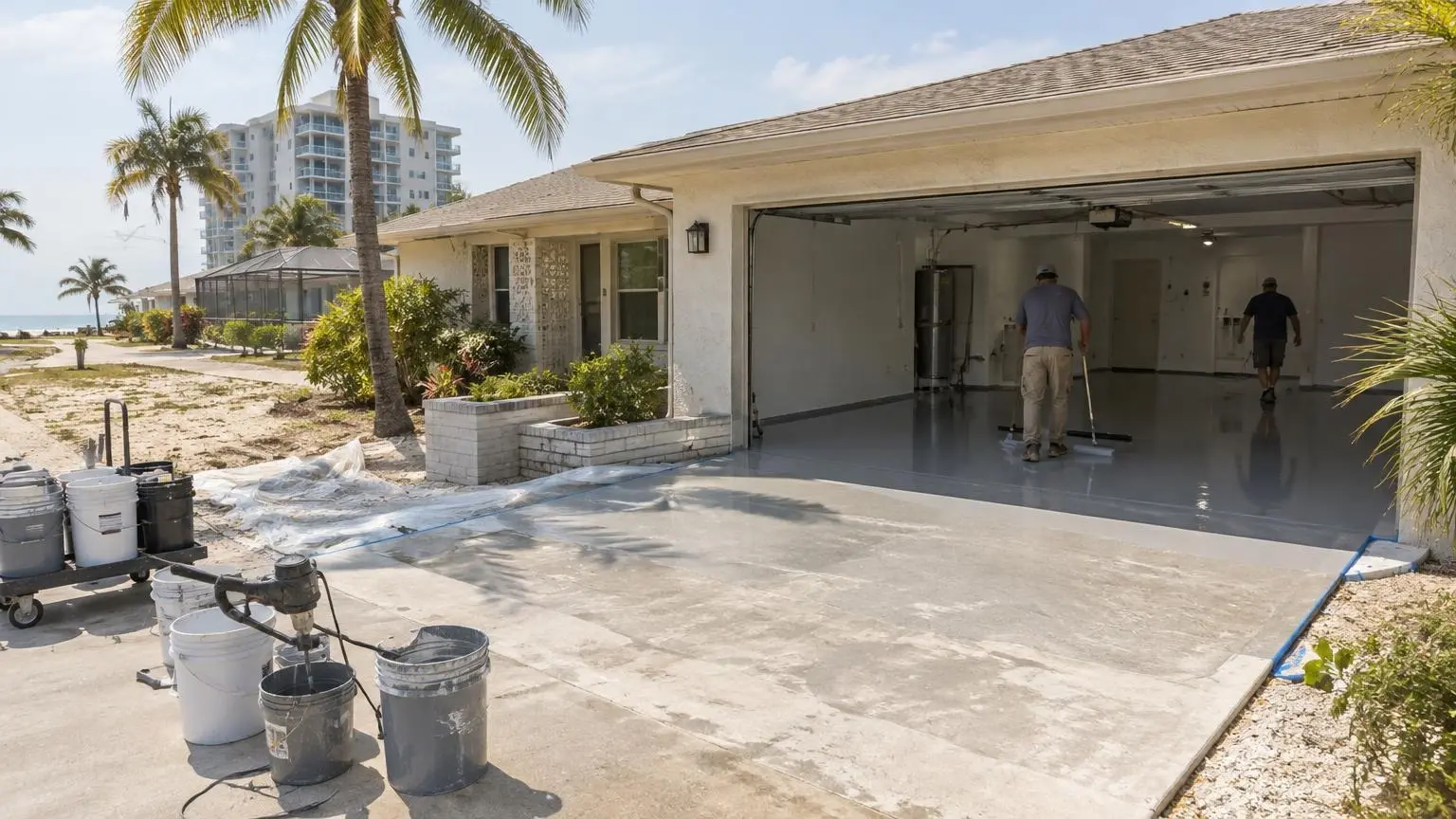
Epoxy flooring in Daytona Beach covers more ground than most people expect, because the city itself is a patchwork. Daytona, Daytona Beach, Kingston and Seabreeze were separate towns until they merged in 1926. The Halifax River lagoon still splits the city in two, with four free bridges tying the mainland to the beachside. A garage off Ridgewood and a garage a few blocks from the ocean sit in the same city limits, yet the floors we find in them are often very different.
Reading a Daytona Beach slab by its decade
Housing here was built in waves. American Community Survey figures summarized by Point2Homes show about 10.4% of the city's homes went up in the 1950s and another 10.4% in the 1960s. The biggest wave came later, with 18.3% from the 1970s and 22.1% from the 1980s. Building picked up again after 2010, and 5.7% of homes date from 2020 or later. Each era leaves its own floor behind.
- 1950s and 1960s homes: thin slabs, old carports turned into garages, and layers of paint from owners past. Grinding takes longer, and we budget for patching.
- 1970s and 1980s homes: the bulk of the city. Expect settlement cracks, oil-soaked parking spots and worn sealers that must come off.
- Homes built since 2010: sound concrete with a smooth, hard-troweled finish. A coating will not grip it until it is diamond ground.
A renters' city
More Daytona Beach homes are rented than owned. The same ACS summary puts renter-occupied units at 52.5%. Close to half of all housing is in buildings with two or more units. Landlords and property managers call us for a practical reason. A sealed garage or utility room floor wipes clean between tenants, hides wear under flake, and does not soak up oil the way bare concrete does. For rentals we usually suggest a mid-tone flake with a polyaspartic topcoat. It turns around fast, and scuffs barely show.
Bikes, cars and race fans
NASCAR and International Speedway Corporation are headquartered here, and Bike Week and Biketoberfest bring several hundred thousand riders to the area each year. Plenty of residents keep a motorcycle, a project car or a trailer in the garage. Kickstands dig into soft coatings, and hot tires can lift cheap ones. For those floors we build thicker, with a full flake broadcast that spreads the load, and we talk through hot-tire pickup before we pick a topcoat. A garage set up as a show space is also a natural fit for metallic epoxy.
Beach sand rides home on the tires
Wikipedia notes the city has more than 23 miles of public beach, and cars are allowed on parts of it. Anyone who drives the beach brings sand back in the wheel wells, and it ends up on the garage floor. Fine sand acts like sandpaper under shoes and tires. A flake floor with enough texture holds up to that grit, and a quick rinse sends the sand out the door instead of into the pores of the slab.
Beachside versus mainland
On the beachside, homes and condos sit between the river and the ocean. Salt air leaves a film on garage floors and on anything metal, and storms push sand and water under doors. We clean that film off with grinding right before coating, and we lean toward textured flake finishes that hide sand between rinses. On the mainland, the slabs are more often the issue than the air. Older neighborhoods west of the river have more converted carports, add-on rooms and patched concrete. There we spend more of the job on prep: grinding off old paint, filling seams and leveling low spots near the door. The coating system may be the same on both sides. The work it takes to get there often is not.
Planning around the calendar
Daytona Beach averages 51.25 inches of rain a year, mostly from June through September. The record for a single day is 12.85 inches, set in October 1924. Wikipedia also notes that late winter and early spring are often very dry. For outdoor work on lanais and pool decks, those drier months are the easiest time to schedule. Garage work goes on all year, but in summer we start early and read the dew point before each coat.
Commercial floors in a working city
The city's largest employers include Halifax Health, AdventHealth Daytona Beach, Embry-Riddle Aeronautical University and Daytona State College. Manufacturing sites sit in an enterprise zone and a foreign trade zone next to the airport. We coat shop floors, service bays, storage rooms and back-of-house areas for businesses like these. Commercial jobs are scheduled around your hours, and we can work in sections so part of the floor stays open.
How we price a Daytona Beach floor
We measure the space, test the slab for moisture and note every crack and old coating. Then you get one written price with the prep, each coat and the total spelled out. Call (386) 272-6158 or
to set up a visit.Rooms beyond the garage
Not every Daytona Beach job is a garage. Many homes here sit on a slab with no basement, so a coated concrete floor can serve as the finished floor in a sunroom, a home gym or a converted garage room. Metallic epoxy suits those spaces when looks matter. A plain color coat with a light texture suits a laundry or storage room. We check the slab for moisture first, since a room floor is harder to empty out if anything goes wrong.
Daytona Beach Facts That Shape Your Floor
- Four towns became one. Daytona, Daytona Beach, Kingston and Seabreeze merged as Daytona Beach in 1926. The Halifax River lagoon still divides the city, crossed by four toll-free bridges.
- Housing built in waves. About 18.3% of homes date from the 1970s and 22.1% from the 1980s, with another 20.8% from the 1950s and 1960s combined (ACS, via Point2Homes).
- More renters than owners. Renters occupy 52.5% of occupied homes, and about 41.3% of all units are single-family detached houses.
- Wet summers, dry springs. Average rainfall is 51.25 inches a year, mostly June through September. Late winter and early spring are often very dry, which suits outdoor coating work.
Daytona Beach Questions
Can you coat a garage in a Daytona Beach rental between tenants?
Yes. Most two-car garages take one to two days with a polyaspartic system, and the floor can usually take foot traffic the next day. We schedule around your turnover dates and give you written care instructions to pass on to the next tenant.
Will a motorcycle kickstand damage an epoxy floor?
A kickstand puts a lot of weight on a small point. A thin coating can dent or chip under it. We build bike garages with a full flake broadcast and a hard topcoat, and we suggest a small kickstand pad for bikes that stay parked in one spot for weeks.
Is it better to coat my lanai in summer or winter?
Late winter and spring are usually easier. Daytona Beach gets most of its rain from June through September, and afternoon storms can interrupt outdoor work. Garage floors can be done any month because we can close the door while the coating sets.
Free Estimates in Daytona Beach, FL
Free written estimates on both sides of the Halifax River in Daytona Beach.
Epoxy Flooring Near Daytona Beach
- Epoxy Flooring in Ormond Beach, FL
- Epoxy Flooring in Ormond-by-the-Sea, FL
- Epoxy Flooring in Holly Hill, FL
- Epoxy Flooring in South Daytona, FL
- Epoxy Flooring in Port Orange, FL
- Epoxy Flooring in Daytona Beach Shores, FL
- Epoxy Flooring in Ponce Inlet, FL
- Epoxy Flooring in New Smyrna Beach, FL
- Epoxy Flooring in Edgewater, FL
- Epoxy Flooring in Oak Hill, FL
- Epoxy Flooring in Samsula-Spruce Creek, FL
- Epoxy Flooring in DeLand, FL
- Epoxy Flooring in Deltona, FL
- Epoxy Flooring in DeBary, FL
- Epoxy Flooring in Orange City, FL
- Epoxy Flooring in Lake Helen, FL
- Epoxy Flooring in DeLeon Springs, FL
- Epoxy Flooring in Palm Coast, FL
- Epoxy Flooring in Flagler Beach, FL
- Epoxy Flooring in Bunnell, FL